Siempelkamp and Taishan Gypsum complete Asia’s high-end gypsum fiberboard production line
Siempelkamp and Taishan Gypsum complete a 20-million-m² gypsum fiberboard production line in China using advanced pressing technology and recycled materials.
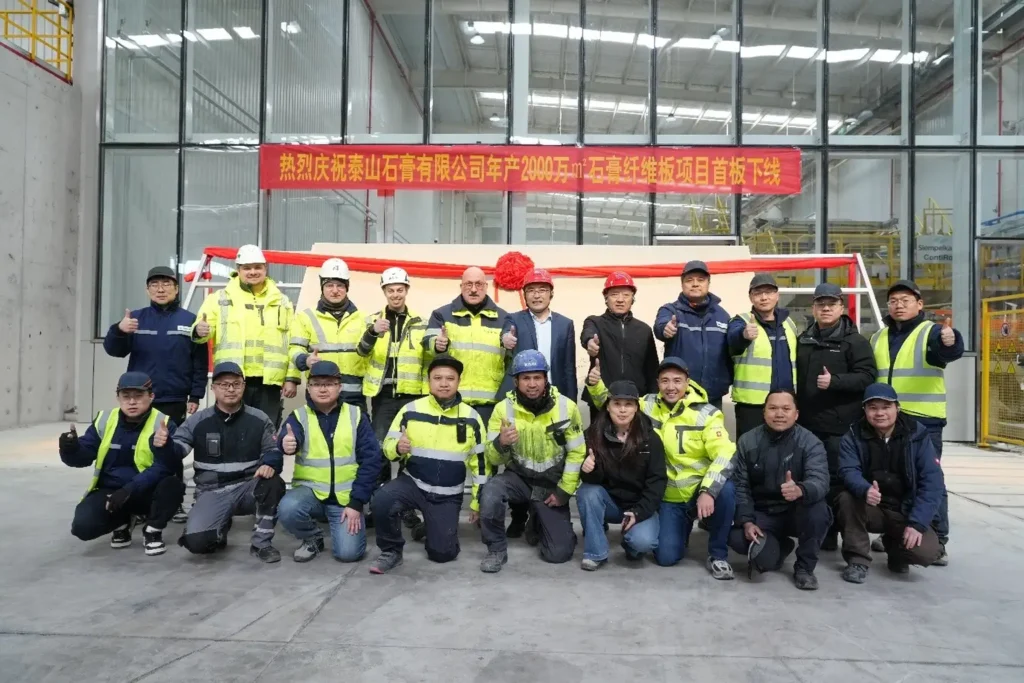
New 20-million-square-metre production facility in China combines advanced continuous pressing technology with recycled raw materials, marking a significant development in sustainable board manufacturing.
German plant engineering specialist Siempelkamp and Chinese building materials manufacturer Taishan Gypsum have successfully completed the acceptance of a major gypsum fibreboard production line in China. The facility, accepted on September 4, 2026, is being positioned as Asia’s first high-end production line of its kind and is expected to become one of the largest globally.
The project marks an important milestone in the development of advanced gypsum fibreboard manufacturing, bringing together Siempelkamp’s machinery and process engineering expertise with Taishan Gypsum’s research and development capabilities.
A major investment in advanced board manufacturing
Representing an investment of RMB 530 million, the new production facility has a designed annual capacity of 20 million square metres of gypsum fibreboard.
The project was formally initiated with the signing of the contract in January 2025, followed by the start of construction in August 2025. The partners completed equipment installation and commenced initial trial production within six months. Subsequent commissioning and process optimisation paved the way for successful acceptance in September 2026.
A key feature of the facility is Siempelkamp’s ContiRoll® continuous wet pressing technology, integrated with efficient drying systems. The production line incorporates a fully automated manufacturing process covering raw material mixing, board forming and quality control.
The technology is designed to support consistent production quality while enabling large-scale manufacturing.
Recycled materials at the heart of production
One of the most significant aspects of the project is its approach to raw material utilisation.
The gypsum fibreboards are manufactured using flue gas desulphurisation (FGD) gypsum recovered from power plant residues. Recycled plant fibres are incorporated as reinforcement, with the fibre materials including recycled cardboard and pulp residues from paper mills.
According to Taishan Gypsum, the boards meet China’s ENF environmental classification requirements and A1 fire protection classification. They are also designed to offer high strength and resistance to water and moisture.
At full production capacity, the facility is expected to process more than 300,000 metric tonnes of industrial solid waste annually. Taishan Gypsum also estimates that the manufacturing operation could reduce CO₂ emissions by approximately 16,000 metric tonnes per year.
This approach highlights the potential of industrial by-products and recovered materials as valuable resources for next-generation building products.
Expansion plans signal further growth
The successful completion of the production line could be the beginning of a much larger expansion programme.
Taishan Gypsum plans to commission nine additional production lines in China during the country’s 15th Five-Year Plan period (2026–2030). The proposed expansion would increase its total annual production capacity to 200 million square metres, establishing one of the world’s largest gypsum fibreboard manufacturing bases.
The boards produced at the new facility have already been used in several high-end construction projects, indicating the commercial potential of the technology.
Strengthening industrial technology partnerships
The project also demonstrates the importance of international technology partnerships in advancing industrial manufacturing.
Commenting on the achievement, Kosta Karakolidis, CEO of Siempelkamp Qingdao, acknowledged Taishan Gypsum’s trust and the dedication of the project teams.
Samiron Mondal, CEO of Siempelkamp’s Capital Business Unit, highlighted the project’s benchmarks in production scale, technological progress and innovation.
For the wider panel manufacturing industry, the development offers an interesting example of how continuous pressing technology, automation and alternative raw materials can come together to create new opportunities beyond conventional wood-based panels.
As manufacturers increasingly explore resource-efficient production and circular material solutions, developments such as this could play an important role in shaping the future of industrial board manufacturing.
About The Author