World Teak Conference highlights advancement of sustainable teak production
The World Teak Conference, jointly organised for three-days, by the International Tropical Timber Organisation (ITTO), TEAKNET—the global network of teak stakeholders—and the Kerala Forest Research Institute (KFRI), issued nine key recommendations to promote sustainable teak production and expand trade opportunities, organisers said.
World Teak Conference
The World Teak Conference, jointly organised for three-days, by the International Tropical Timber Organisation (ITTO), TEAKNET—the global network of teak stakeholders—and the Kerala Forest Research Institute (KFRI), issued nine key recommendations to promote sustainable teak production and expand trade opportunities, organisers said.
The event attracted over 300 delegates, including experts, researchers, and industry representatives from 40 countries. Titled “Promoting Quality Timber Production in Smallholder and Community-based Teak and Other Valuable Species Plantations in the Tropics” and supported by the Government of Germany, the project has been under implementation since 2023 in Cambodia, India, Indonesia, Thailand, Togo and Viet Nam.
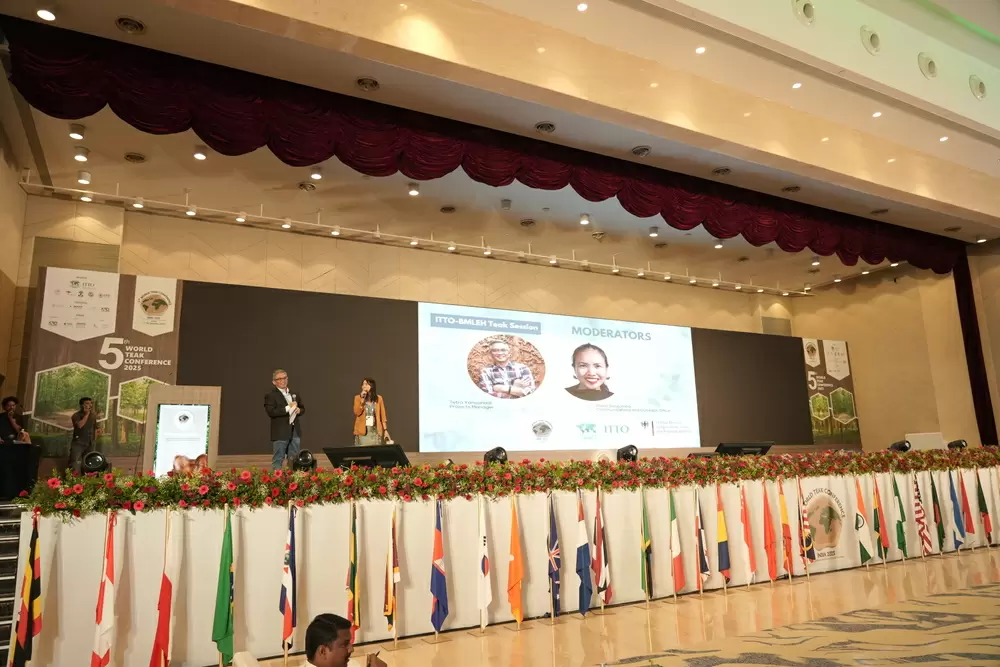
Opening the conference session, ITTO’s Executive Director Sheam Satkuru said supporting the production of high-quality teak was central to ITTO’s mission to encourage sustainable forest management and promote legal and sustainable tropical timber supply chains. Teak, one of the world’s most valuable hardwoods, is now planted for large-scale cultivation in more than 80 countries in Africa, the Asia-Pacific, and Latin America. However, smallholders and community-based plantations still face challenges that ITTO and its partners are seeking to address.
According to a statement by the organisers, the recommendations include promoting mixed-cropping plantations instead of traditional monocultures, supporting research to strengthen agroforestry-based systems, adopting eco-friendly phytosanitary measures for imported wood, and utilising artificial intelligence for surveys and monitoring.
“ITTO is making efforts to fill the gaps and create the capacity necessary to surmount these concerns,” Ms Satkuru said. Detailing developments in India, R. Yashoda, Chief Scientist at ICFRE-Institute of Forest Genetics and Tree Breeding, said selected and cloned planting materials that could be harvested after just 20–25 years offered smallholders a way to maximise the economic returns from plantations more typically operated on much longer rotations.
Dang Thinh Trieu of the Vietnamese Academy of Forest Science identified four key avenues along which Viet Nam has promoted high-value teak timber and sustainable supply chains: improving teak genetics; enhancing silvicultural techniques, training in silvicultural practices; and disseminating knowledge via radio, newspapers, and television.
Ms Satkuru closed the session, highlighting that the teak industry can only advance “if we showcase science, policy, and practical interface,” noting that the milestones of the ITTO-BMLEH project exemplify it and are promising for scaling up further.
Source: ITTO/PTI